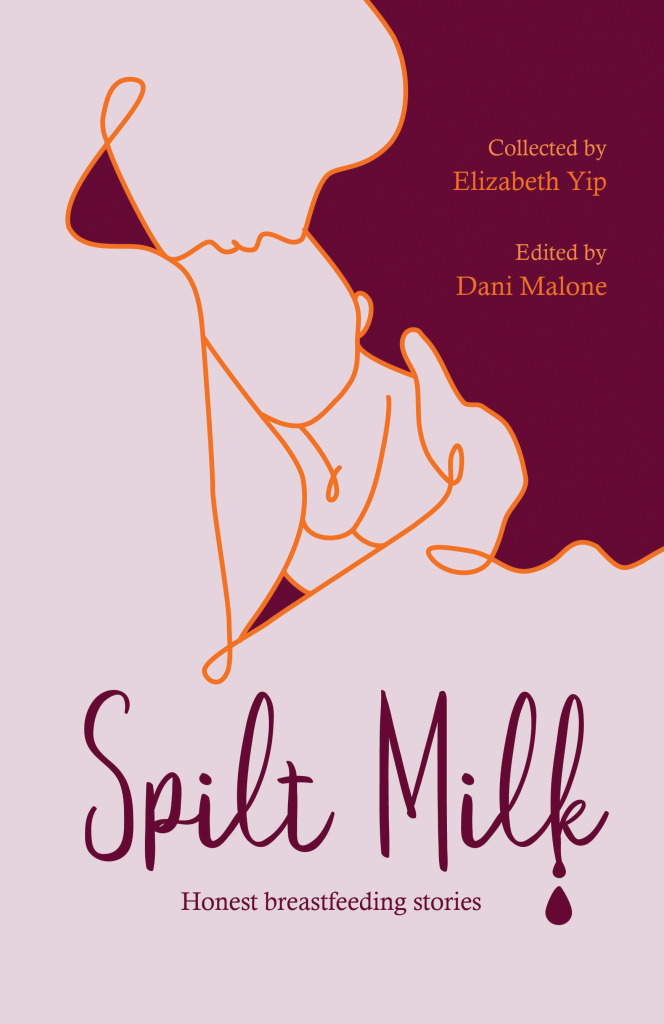
Spilt Milk: Honest Breastfeeding Experiences
A legacy, by mothers, for mothers
Discover 80 true stories of the journey through motherhood in our collection of beautiful accounts, showcasing the honesty, humour, and relatable moments of new motherhood.
New Book lifts the lid on women’s experiences of breastfeeding
NEWS RELEASE ON THE LAUNCH OF THE BOOK IN AUSTRALIA
One of the most personal and intense aspects of mothering, breastfeeding is all too often assumed to be simple, the most natural thing in the world.
But as is evident in the new publication, Spilt Milk, while breastfeeding can be wonderful and trouble-free, for many mothers it is difficult, confusing, painful, and can leave them wracked with guilt and susceptible to depression.
Spilt Milk features the recent and retrospective experiences of more than 80 mothers and includes reflections from fathers and partners.
The collection, gathered by nurse, midwife, and lactation expert Elizabeth Yip and edited by Dani Malone, is a deep dive into breastfeeding and includes a useful preface on how lactation works for mothers and babies.
Malone, whose own experience of breastfeeding was difficult, says the book reflects truths and realities that are rarely discussed openly.
“There is a lot of public conversation about birth, delivering a healthy baby being the end game, but that is only half the journey,” she says.
“The critical weeks of bonding with a new baby and adjusting to breastfeeding are not well understood and the idea that feeding problems can continue into the first 12 months of a child’s life rarely makes the spotlight.
“In an age where we fully understand the vital benefits of breastfeeding for good health over a lifetime, the sense of failure when breastfeeding is not straightforward or becomes impossible, can’t be underestimated.
“Many of the stories shared in the book reflect a courageous journey to give newborns the best start possible and to breastfeed even if only for a limited time, and through every journey there shines the mothers’ love and commitment.”
Malone says the book provides a rare insight into the broad spectrum of experiences of breastfeeding and as such she hopes it will give new mothers and their partners a better understanding that there should be no judgement about the process.
“Being able to tap into other women’s experiences makes all the difference in understanding the huge range of what is normal in breastfeeding,” she says.
“All of these women have had a passion to nourish their children in the best way possible, but their stories really highlight how different each experience can be – for some women it’s a breeze and for others, a mission impossible.
Let’s get real
We celebrate the power of birth, but it’s easy to forget the power of women after they have delivered.
The stories in this book are riveting. From the blissfully easy serenity of feeding a new baby on demand, to traumatic struggles with an oversupply of milk, mastitis, blistered nipples, or low milk production, leading to fractious babies, sleep deprivation and an abiding sense of failure.
What is clear from this book, is that no two women or their experiences of feeding their babies are the same. Supporting their efforts in that context continues to be vital. For all mothers.

Chapter examples and posts
Get a look at some of the content covered in the book.
About the Book
Why Mums and Health Professionals Should Read Spilt Milk
Spilt Milk: Honest Breastfeeding Stories is a deeply honest and compelling anthology that brings together the experiences of more than 80 mothers—from the joys of calm, on-demand feeds to the anguish of oversupply, mastitis, blistered nipples, low milk production, and heartbreak over unfulfilled expectations. Collected by nurse, midwife, and lactation expert Elizabeth Yip, and lovingly edited by Dani Malone, the book also offers a clear preface explaining the mechanics of lactation—a valuable resource for those both living and supporting the breastfeeding journey.
For mothers, this collection offers comfort, companionship, and validation—an affirmation that there is no single ‘right’ way to breastfeed. Each story is unique, and their diversity underscores that doing your best—regardless of challenges—is more than enough. For health professionals, the book serves as a crucial reminder that breastfeeding support must be as individual as the families they care for. It highlights how rigid healthcare systems and unrealistic ideals can unintentionally compound feelings of inadequacy or guilt.
Spilt Milk is both a mirror and a guide: a mirror for mothers seeking resonance and reassurance, and a guide for professionals striving to provide empathetic, flexible, and respectful care.
About the editor
Dani Malone is the editor of Spilt Milk. Dani’s motivation for the project is deeply personal—after giving birth, she experienced a significant low milk supply that left her feeling isolated, guilty, and unsupported. Determined to help others feel less alone, she worked to create a space where mothers could share the full spectrum of feeding experiences—whether joyful, painful, or somewhere in between. Her empathetic editing gives equal weight to triumphs and struggles, challenging the idealised image of breastfeeding and encouraging flexibility, self-compassion, and understanding. She lives in Australia and continues to write about motherhood and women’s wellbeing
What readers said
★★★★★
Importantly the stories help us to understand that we are not alone and that there are no score cards for breastfeeding, doing your best is enough.
★★★★★
I really wish there had been a book like this, when I had my baby.
★★★★★
This is such a lovely companion for new mothers. Perfect for those 3am feeds!
-
About Liz, our collector of stories
Liz Yip’s lifelong passion for women-and-babies’ healthcare, was the spark that lit Spilt Milk, Honest Breastfeeding Stories. She has dedicated her more than 40 years as a midwife to supporting new mothers though their early feeding joys and challenges.
Liz says the book celebrates and acknowledges mothers from all walks of life.
“In the not so distant past the image of a ‘good mother’ was one who breastfed,” she says.
But we know while most women can produce some breastmilk, many, for a range of reasons, will have trouble in producing enough milk for babies to thrive. We also know that the western health care system has often touted restrictive rules around the process and practice of feeding, sometimes confounding mothers’ efforts to persist”.
